Thank you for reading this.
Sometimes I think if you didn't read this, no one would.
But you do. I get mail from faraway places — like Oregon — asking:
"If you dislike the birds so much, why do you watch them?"
All I have ever tried to do as a weekly wilderness gossip columnist was to share my love of the silence of nature.
Silence may be the rarest thing on Earth.
Often instead of basking in the reverie of the silence of the wilderness, I am forced to endure the mating and nest making rigmarole of some river pest, like the dipper.
It's a drab little river bird that never stops bouncing.
It could give you a nervous twitch if you watched it very long.
But I never knew it ate salmon.
A keen-eyed Alaskan reader set me straight on that one.
Apparently a pair of dippers ate an estimated 2,000 baby chum salmon a month at the spillway of the Neets Bay fish hatchery near Craig in the 49th state.
We'll have to add the dipper to the list of hundreds of species flora and fauna that are salmon-dependent.
Even the trees of the rain forest were, until recent times, fertilized with the carcasses of salmon that were spread through the woods by bears and high water.
Eliminating the salmon runs has led to a collapse of ecosystems.
The dipper could be an indicator species like the canary in the coal mine.
If the canary dies, you know the air is bad. If the dippers go away, it means the river is dead.
We like to study the problem.
A disturbed reader from Montana asked: "Won't electro-shocking, shaving and netting the marmots endanger them?"
It sure will, but that's no excuse to not study them. These same survey methods have been used for years on fish.
Electro-shocking is an evil practice of running an electric current into the water to immobilize fish so you can count them.
My fancy friends at the Dungeness Hatchery used electro-shocking to gather a captive brood stock to restore the spring chinook back in the '90s -- until they found out 40 percent of the chinook smolts captured in this manner developed spinal abnormalities.
Electro-shocking larger fish is even worse, since they receive more current.
Electro-shocking fish has been outlawed in civilized countries like Montana.
It is still legal here.
There was even a picture of this brutal technique in action on Page 13 of this year's Washington fishing law booklet.
Still, electro-shocking only kills, maims and injures fish and their eggs buried in the gravel.
Another survey weapon in the biologist's arsenal, the smolt trap, can choke off an entire stream.
Smolt traps catch young salmon migrating downstream out to sea.
It can be a valid scientific method for gathering survival data, but not if it blocks the whole stream.
Blocking a salmon stream is illegal.
It was the very first fishing law ever put on the books, more than 800 years ago by Richard the Lionheart.
His reign was described as an "orgy of medieval savagery," but he didn't block a salmon stream.
In the spring, the steelhead migrate upriver.
They like to spawn in the small side steams, running as far up as they can at night.
The sea-run cutthroat swim with the steelhead, as far as they can in the high water, to spend the summer deep in the rain forest.
Not if the creek is blocked by a smolt trap.
Meanwhile, the poor smolts caught in the traps are in danger of floods, predators and rough handling.
Somewhere Richard the Lionheart is rolling over in his grave.
Showing posts with label Olympic marmot. Show all posts
Showing posts with label Olympic marmot. Show all posts
Wednesday, April 7, 2010


Wednesday, March 31, 2010
Olympic marmot survey
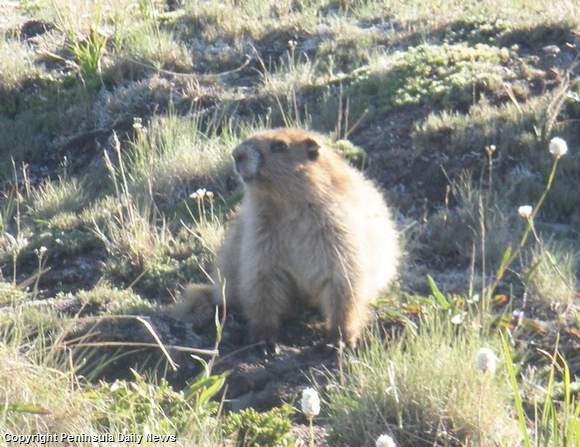
I'm through writing this column once I get my new job as a marmot surveyor.
I am uniquely qualified for this position. I have spent years studying the Olympic marmot in an attempt to decipher their language.
It's a series of whistles that are loud enough to make you think the police are coming.
The marmots whistle to warn of predators, defend their burrow complexes against other marmots and make fun of the hordes of granola-crunching backpackers.
The marmots spend the short alpine summer harvesting herbs and grasses, drying them on the scenic front porches of their burrows located high on the mountainside.
Then they spend the long winter, sleeping deep beneath the snow.
Biologists think the number of marmots in Olympic National Park could be depressed by anything from climate change to coyotes.
If the marmots are depressed, they could be endangered. If they aren't endangered, they should be.
Volunteers have been asked to survey the marmots. That could be difficult since the marmots live underground most of the time.
To get an accurate count of the marmots, we may have to borrow a page from the fish surveyors' playbook and electroshock them.
Fortunately, we still have the Elwha River dams for a supply of cheap and reliable electricity. All we need are a few miles of cable and some zircon encrusted electrodes.
We'll run some juice down their holes and see if the marmots don't just scamper out and get counted.
Once we count the marmots, then what?
Methodologies have yet to be developed to ensure we don't count the same marmot twice.
This would be problematic since increased numbers of the marmot would lessen its chances of being endangered.
Sure the marmots are cute, but they all look pretty much the same.
Paint-balling the marmots with a permanent dye to make them easier to identify has been suggested, but weapons are unpopular in Olympic National Park.
Once again we'll take a cue from fisheries management. They cut various fins off the fish to identify them.
The marmots don't have fins, so we'll shave them. Any marmot with a bad haircut means it's already been counted.
Then, we'll attach a radio collar with a webcam to the marmot and see if it can still fit back in its hole.
Any responsible marmot survey would have to include tribal co-management.
Native Americans traditionally hunted marmots for their meat and skins.
Once the survey is completed, harvestable numbers of breeding marmots could be netted and sold to trendy local restaurants and join wild steelhead on the menu.
I know what you're thinking.
What if aggressive survey techniques and a commercial harvest are not successful at making the Olympic marmots endangered?
Time for another fisheries management time-honored tool:
We'll increase the number of predators in the ecosystem until the population of prey species tweaks. That's where the fishers come in.
I can't say for sure that this large member of the weasel family eats marmots, if they don't they should.
While there was no mention of monetary compensation for the marmot surveyors, there was no money in bull trout either — until it was endangered. Now it's worth about a billion dollars a year.
It is my hope that by using a few simple management strategies and study methodologies borrowed from the salmon restoration industry, we could have the marmot declared endangered in my lifetime.
Once something is on the endangered species list, it doesn't matter how it got there. It forces the floodgate for federal funding for further studies.
Those who ignore history are normal.
Subscribe to:
Posts (Atom)
