Slide Show

Showing posts with label Olympic Peninsula. Show all posts

Wednesday, May 26, 2010

Dairies put out to pasture

These days it seems like people don’t know where their food comes from. That was not a problem growing up on a cattle ranch. OK, maybe it wasn’t a ranch.
We only had the one cow.
Soupbone had all the makings of a champion bucking cow. At the time I thought I had a big future as a bucking cow rider at the rodeo. I was ahead of my time out standing in my field. Soupbone was pretending to be asleep in the shade, while chewing his cud and swatting flies with his tail.
I snuck up and hopped on his back and rediscovered why people don’t ride cows much.
Soupbone shot up in the air like a big hairy rocket.
After landing I got some static from the parental guidance committee about how I had to stop riding that cow before it got so tough you couldn’t get a fork in the gravy.
That was life on the farm. Just when you got one barnyard buddy trained, they’d disappear and you had to get another one. 
Those were the good old days. We went to a dairy farm for our milk. There was always something going on in the barn.
The farmer would mark our height on the barn door to make sure we were still growing fast enough. He would tell us we had to drink a lot of drink milk to keep from being “runts.”
There was a giant stack of hay to climb with a pack of wildcats that you could try to pet.  There was a pen full of calves that you could pet no problem. 
We got to choose a couple of them to take back home to the ranch. The farmer gave us a kitten to go with the calves and of course a couple of gallons of milk. 
We named the calves Frisky and Petunia. They were going to be my ticket to the big-time rodeo circuit. I was going to train them but they had a lot of growing up to do first. For starters we had to feed them from a bucket with a big nipple on the end of it.
It was fun to mix up the formula with the warm water being careful not to get it too hot.
Frisky and Petunia were highly intelligent cows. They took about two minutes to figure out the bucket and start pulling for all they were worth.
I was glad I wasn’t a real mommy cow. It looked painful.
After a bucket of hot milk there was time to join in all the cow games the herd loved to play like tag or butting heads.
I had hoped the calves would grow into Texas Longhorns but no such luck. All they had were a couple of puny spikes coming out of their heads.
Before long we started feeding them cereal and choice handfuls of clover and timothy. Soon the calves grew too big to feed with a bucket of formula but they never outgrew their love of play.
You had to be careful about getting caught out in the pasture. The calves might want to play tag and butt heads just for old times’ sake. They forgot they weighed hundreds of pounds!
Once the cows got that big, it was time to break them into riding cows. I would have preferred a horse but that’s life on the range. You have to make do with what you got. Breaking a riding cow is not for everyone. You have to outsmart them first. I’d bait the cows with the grain bucket. Dodging the flashing horns, I’d sneak a halter and a lead rope on one of the cows and wait for them to lie down in the shade and go to sleep. Then it was just a matter of sneaking up and slowly easing into the saddle, except there was no saddle.
That made for riding a painful experience. Frisky and Petunia were real lookers but they were razor-backed and pot bellied. Sitting on top of those critters was like riding a rail on top of a fifty gallon drum. The ride did not last long. We never made it to the rodeo. The calves grew up and went away and so did I.
When I got home the farms were gone. The dairy where we got our milk, calves, kittens and our height measured on the barn door was gone too.
It is hard to imagine that there were once 9,000 cows grazing within a five mile radius of Sequim. The first dairy cows were dumped off a sailing scow by Elliot Cline, (for whom Cline Spit is named) back in 1861.
With the passage of the Homestead Act and the removal of the Indians, dairy farms were established along the shores of the Strait of Juan de Fuca. In 1891 a dock was built in the new town of Dungeness to ship butter and cream to Seattle.
Dungeness was described as “The most prosperous place on the Sound, surrounded by the richest farming country.” As the land was settled, the new arrivals, what the Indians called “Jimmie Come Lateley’s,” had to move inland to the Sequim Prairie and the hills beyond.
In the summer of 1895 four farmers got together at James Grant’s homestead farm to try to figure out how to make a living on the Sequim Prairie. Back then the Sequim Prairie was a 1,500 acre savannah grassland. It was one of many prairies that occurred throughout Western Washington. Native Americans maintained the prairies by burning them every three to five years, for generations.
The prairies attracted game and propagated camas, wild strawberries, ferns and other plants that were used for food, fiber, medicine and cosmetics.
The earliest setters on the Sequim Prairie turned the hogs loose. They rooted the prairie right down to the cactus, which gives you an idea how dry it was.
The Sequim Prairie is in the rain shadow of the Olympics Mountains where rainfall averages less than 17 inches a year. Farmers tried growing wheat and oats until plagues of grasshoppers ate everything, including the stinging nettles and moss right down to the fence rails.
One of Grant’s neighbors was called “Crazy Callen” because of all his odd ideas.
What may have been Crazy Callen’s best idea was to dig an irrigation ditch from the Dungeness River.
Callen had seen this kind of irrigation work in Colorado so he figured it would work in Sequim. The farmers set to work with picks and shovels and dug a ditch all winter until the water reached the prairie on May 1, 1896.
Then they all sat down for a picnic. This became the Sequim Irrigation Festival. It is the oldest community celebration in Washingon.
Once the Sequim Prairie was watered it became the state dairy center that held the world’s herd record in butterfat production per cow.
In 1916, Donald McInnes Sr. built what was then the largest dairy barn in the state of Washington. It is one of the few barns that survive, still standing just west of Jamestown. The barn measures 180 feet long and 45 feet high at the peak of the roof. It had stanchions to milk 104 cows.
In the 1950s there were said to be 300 dairies in Sequim. By 1966 there were 90. Sequim became a retirement community. By the 1970s there were only a couple of dozen surviving dairies.  The rest of the farms were subdivided into housing developments.
Real estate agents replaced dairymen. The irrigation ditches were put into plastic pipes to reduce water lost to evaporation.
In 2010, there are two dairies left in the Dungeness Valley. There could soon be only one.
The Dungeness Valley Creamery has been declared habitat for the endangered bull trout. It is a fish that is neither endangered nor a trout.
It is a voracious predator.
In 2009, more than100,000 Chinook salmon smolts were released in the upper Dungeness River. An estimated 2,000 smolts survived their trip downstream to the saltwater. The rest were eaten by the bull trout and other predators.
Clallam County plans to ‘restore’ the bull trout by purchasing property from willing sellers, moving the flood control dikes and planting native vegetation.
Dairy farmer Jeff Brown, owner of the Dungeness Valley Creamery is not a willing seller. He plans to pass his farm on to his children.
Once the dike that protects his farm from the Dungeness River is moved, he could be forced to become a willing seller.
Brown, a life long dairy farmer, recently joked about his farms’ fourth anniversary of battling the myriad hostile governmental agencies he has had to deal with since starting The Dungeness Valley Creamery and opening a store on his farm.
“I should just give up on the dairy and grow marijuana,” Brown said, referring to what is now estimated to be the largest cash crop in Washington. “I’d probably get less hassle from the government than trying to be a natural food producer in Clallam County.” 
It makes you wonder where your food comes from.


Saturday, May 1, 2010

Got them ol' punch card blues

April can be  the cruelest month. It's when we are forced to turn in our income tax and turn in our punch card.
The first punch cards were to record an anglers' catch of salmon and steelhead.
They were free. We knew that was too good to last.
Before long, they started charging for punch cards and making us punch other stuff like crab, halibut and sturgeon.
Today's punch card is a complex legal document that has grown so large you must roll it up like a medieval scroll to carry it around.
The law says you must record immediately, in ink, the date, catch location and, in the case of salmon and steelhead, identity of the fish as hatchery-bred or wild.
For a steelhead fisherman, this can be a real challenge.
Imagine standing over the top of your boots in a freezing river in a blizzard. It's is your lucky day. You caught a steelhead.
Now you must waddle to shore and begin the complex legal process of recording your catch.
First, it might be handy to have an ink pen that functioned on wet paper in the snow.
But before you can write the location of your catch on the punch card, you must figure out where that is.
You can't just write the name of the river, no. You must find the secret identification code of each river located somewhere in the fishing law book.
Inevitably, you give up trying to find the secret code. You try to write the name of the river in the space provided.
Your fingers are frozen. You scribble something that looks like an ink blob.
Punch cards are a real hassle for crabbers.
Imagine standing over the top of your boots out on the tide flats. It's your lucky day.
You scoop up a crab. You unroll your punch card document and invariably drop it in the water.
Again, you fill out your punch card with something that looks like an ink blob.
Filling out a punch card for salmon or halibut is no picnic, either.
Imagine bobbing around in an ocean swell trying to hold down a greasy breakfast while breathing a heady mixture of salt air, rotting herring and outboard motor exhaust.
It's your lucky day. You catch a salmon or halibut but you don't care. You only want to be put on shore or put out of your misery.
You fill out your punch card with another ink blob.
For years, we have been told that the state bean-counters could look at these ink blobs to come up with catch numbers with a method known only to professional fortunetellers.
Nowadays, they have a brave new way to count the catch: computer models.
No one bothered to look at the punch cards before they cut this year's halibut season to just 13 days.
How could they? The punch cards that show last year's catch haven't been sent in yet.
Instead of actually counting the catch, the state used a computer model to cut our halibut season -- which begs the question:
Why bother with punch cards if the state is just going to dream up bogus harvest numbers for fish and crab with computer models anyway?
The answer is simple.
Money from punch card sales goes to support the advanced, state-of-the-art computer systems that are required to administer punch card sales.
Someday punch cards might also provide vital funding for more scientific research that could allow the dreamers in the Department of Fisheries to someday design a punch card that anglers can figure out.

Monday, April 26, 2010

Seeing red while fly fishing

Fish has always been a metaphor for life.
In fishing and in life, you must have a vision of your goal. We cast our offering with a force of will into a hidden world hoping to be rewarded.
Success involves timing, skill and luck.
With timing and skill you can make your own luck.
Bad luck can take your eye off the goal and cause you to blindly pound the same dead water with the same dud gear while hoping something will eventually happen.
Albert Einstein said repeating the same failed experiment while hoping for a different outcome was insanity.
I call it fly fishing.
As a fishing guide, I have experienced that fly fishermen can be the toughest to hook up.
When guiding fly fishermen, I insist they use barbless hooks. It makes for less bleeding when they snag the guide.
Fly fishermen often suffer from performance anxiety. It forces them to wade too far, cast too far and spend way too much money on gear, with predictable results.
They go over their waders. Their line piles up in a tangle around their head. The fish are spooked by too much line ripping across the surface of the water.
This can take the enjoyment out of fly fishing.
If your goal is to enjoy fly fishing, I've got a book for you.
I just read The Little Red Book of Fly Fishing (Skyhorse Publishing, 2010) by Charlie Meyers and Kirk Deeter.
They copied the template of Harvey Penick's hugely successful Little Red Book of Golf and opened up their notebooks to reveal an encyclopedic knowledge of fly fishing.
This Little Red Book is told in a language fishermen can understand.
For example, ever had a sore back after a day's fishing? That can be the result of poor posture.
The LRB says that foot railings placed in bars allow patrons to stand for long periods of time by getting one leg up a little higher than the other.
That might explain why a lot of folks do their fishing in the bar.
The LRB says it means you should fish with a rock under one foot.
Let's say you were in that bar and you wanted to throw a glass of beer at someone. You would accelerate as you aim, then stop to let the beer fly.
This is about how tough it is to cast a fly, unless you're a guy.
Fly fishing is a sexist sport. Ask any guide.
If a man and a woman are fishing together on a guided trip, the woman will catch more fish. There are many reasons for this.
Women are patient. They are not competitive. Women listen to instructions, unless they come from their significant other.
There is no faster way to reveal an infinite chasm of misunderstanding in a relationship than to let a man try to teach his wife or girlfriend how to fly fish.
The LRB states that you can learn the hard way or let a professional handle it.
That's what guides are for.
As professionals, fishing guides are routinely forced to become relationship counselors just to keep the The Bickersons from ripping each other's face off — long enough to catch a fish.
I have a secret technique for this. The LRB specifically warns about guides who claim to have secret techniques.
The LRB also deals with the prejudice against outdoor writers because they kiss and tell. For this the authors are unapologetic.
Outdoor writers pass knowledge to the next generation to preserve fish in the future.
That is the goal. 

Wednesday, April 7, 2010

Dipping into the old fishing laws

Thank you for reading this.
Sometimes I think if you didn't read this, no one would.
But you do. I get mail from faraway places — like Oregon — asking:
"If you dislike the birds so much, why do you watch them?"
All I have ever tried to do as a weekly wilderness gossip columnist was to share my love of the silence of nature.
Silence may be the rarest thing on Earth.
Often instead of basking in the reverie of the silence of the wilderness, I am forced to endure the mating and nest making rigmarole of some river pest, like the dipper.
It's a drab little river bird that never stops bouncing.
It could give you a nervous twitch if you watched it very long.
But I never knew it ate salmon.
A keen-eyed Alaskan reader set me straight on that one.
Apparently a pair of dippers ate an estimated 2,000 baby chum salmon a month at the spillway of the Neets Bay fish hatchery near Craig in the 49th state.
We'll have to add the dipper to the list of hundreds of species flora and fauna that are salmon-dependent.
Even the trees of the rain forest were, until recent times, fertilized with the carcasses of salmon that were spread through the woods by bears and high water.
Eliminating the salmon runs has led to a collapse of ecosystems.
The dipper could be an indicator species like the canary in the coal mine.
If the canary dies, you know the air is bad. If the dippers go away, it means the river is dead.
We like to study the problem.
A disturbed reader from Montana asked: "Won't electro-shocking, shaving and netting the marmots endanger them?"
It sure will, but that's no excuse to not study them. These same survey methods have been used for years on fish.
Electro-shocking is an evil practice of running an electric current into the water to immobilize fish so you can count them.
My fancy friends at the Dungeness Hatchery used electro-shocking to gather a captive brood stock to restore the spring chinook back in the '90s -- until they found out 40 percent of the chinook smolts captured in this manner developed spinal abnormalities.
Electro-shocking larger fish is even worse, since they receive more current.
Electro-shocking fish has been outlawed in civilized countries like Montana.
It is still legal here.
There was even a picture of this brutal technique in action on Page 13 of this year's Washington fishing law booklet.
Still, electro-shocking only kills, maims and injures fish and their eggs buried in the gravel.
Another survey weapon in the biologist's arsenal, the smolt trap, can choke off an entire stream.
Smolt traps catch young salmon migrating downstream out to sea.
It can be a valid scientific method for gathering survival data, but not if it blocks the whole stream.
Blocking a salmon stream is illegal.
It was the very first fishing law ever put on the books, more than 800 years ago by Richard the Lionheart.
His reign was described as an "orgy of medieval savagery," but he didn't block a salmon stream.
In the spring, the steelhead migrate upriver.
They like to spawn in the small side steams, running as far up as they can at night.
The sea-run cutthroat swim with the steelhead, as far as they can in the high water, to spend the summer deep in the rain forest.
Not if the creek is blocked by a smolt trap.
Meanwhile, the poor smolts caught in the traps are in danger of floods, predators and rough handling.
Somewhere Richard the Lionheart is rolling over in his grave.

Wednesday, March 31, 2010

Olympic marmot survey

You heard it here first:
I'm through writing this column once I get my new job as a marmot surveyor.
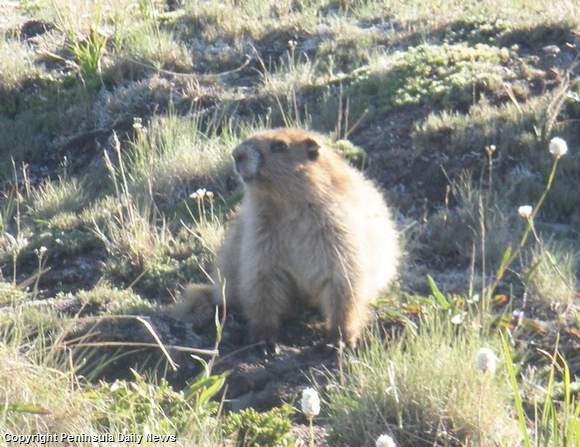
I am uniquely qualified for this position. I have spent years studying the Olympic marmot in an attempt to decipher their language.
It's a series of whistles that are loud enough to make you think the police are coming.
The marmots whistle to warn of predators, defend their burrow complexes against other marmots and make fun of the hordes of granola-crunching backpackers.
The marmots spend the short alpine summer harvesting herbs and grasses, drying them on the scenic front porches of their burrows located high on the mountainside.
Then they spend the long winter, sleeping deep beneath the snow.
Biologists think the number of marmots in Olympic National Park could be depressed by anything from climate change to coyotes.
If the marmots are depressed, they could be endangered. If they aren't endangered, they should be.
Volunteers have been asked to survey the marmots. That could be difficult since the marmots live underground most of the time.
To get an accurate count of the marmots, we may have to borrow a page from the fish surveyors' playbook and electroshock them.
Fortunately, we still have the Elwha River dams for a supply of cheap and reliable electricity. All we need are a few miles of cable and some zircon encrusted electrodes.
We'll run some juice down their holes and see if the marmots don't just scamper out and get counted.
Once we count the marmots, then what?
Methodologies have yet to be developed to ensure we don't count the same marmot twice.
This would be problematic since increased numbers of the marmot would lessen its chances of being endangered.
Sure the marmots are cute, but they all look pretty much the same.
Paint-balling the marmots with a permanent dye to make them easier to identify has been suggested, but weapons are unpopular in Olympic National Park.
Once again we'll take a cue from fisheries management. They cut various fins off the fish to identify them.
The marmots don't have fins, so we'll shave them. Any marmot with a bad haircut means it's already been counted.
Then, we'll attach a radio collar with a webcam to the marmot and see if it can still fit back in its hole.
Any responsible marmot survey would have to include tribal co-management.
Native Americans traditionally hunted marmots for their meat and skins.
Once the survey is completed, harvestable numbers of breeding marmots could be netted and sold to trendy local restaurants and join wild steelhead on the menu.
I know what you're thinking.
What if aggressive survey techniques and a commercial harvest are not successful at making the Olympic marmots endangered?
Time for another fisheries management time-honored tool:
We'll increase the number of predators in the ecosystem until the population of prey species tweaks. That's where the fishers come in.
I can't say for sure that this large member of the weasel family eats marmots, if they don't they should.
While there was no mention of monetary compensation for the marmot surveyors, there was no money in bull trout either — until it was endangered. Now it's worth about a billion dollars a year.
It is my hope that by using a few simple management strategies and study methodologies borrowed from the salmon restoration industry, we could have the marmot declared endangered in my lifetime.
Once something is on the endangered species list, it doesn't matter how it got there. It forces the floodgate for federal funding for further studies.
Those who ignore history are normal.

Bird sounds


Daylight on the  river comes mighty early these days.
It is a peaceful time of day to watch the stars fade away as the sunrise glows across the mountains.
I like to listen to the silence of the wilderness.
Silence is one of the rarest things on Earth.
Unfortunately, silence can be very brief in the wilderness.
There is the pinging call of the boreal owl. It sounds like someone beating a metal wedge that's stuck a round of firewood.
There is the low hooting of the great horned owl.
It sounds like a drunken person trying to imitate a foghorn.
Once the owls stop calling, it's only a matter of time until a murder of crows flies out of its roost like a cawing black amoeba in the clouds.
This evil portend always seems to wake up the woodpeckers.
The pileated woodpecker is a red-crested forest pest about the size of a crow.
This is a normally shy bird that spends it's time jackhammering massive holes in dry snags in search of bugs.
Woodpeckers perform a wilderness public service that rids the forest of insects and provides nesting cavities for other birds.
That is, until their mating season, when woodpeckers begin a destructive practice of drumming on dry wood.
This can be an old snag, a telephone pole or wood-paneled dream home — all the while shrieking an obnoxious call that sounds like a housecat with its tail caught in the door.
Woodpeckers repeat this performance for hours each day for weeks on end until the baby woodpeckers hatch.
Baby woodpeckers can make even more noise with their constant demands for food.
Meanwhile on the forest floor, other birds are making even more noise.
The winter wren, though tiny, makes up for its small size with a long-winded call that can be loud enough to require hearing protection for us sensitive types.
The song of the winter wren is not the bubbly symphony of nature you might think.
The latest scientific research suggests that like most birds, the winter wren is engaged in a viscous form of trash talking other wrens in an effort to win a mate, establish a territory and defend the nest.
Winter wrens may be offensive, but at least they do not occur in flocks.
The pine siskin is a drab little bird with a dismal little call that flits about in huge flocks eating the seeds of trees.
These tiny birds are easily frightened by almost anything.
As is typical with most birds, they can have a bowel movement when they are alarmed. It lessens the payload on takeoff.
Finding yourself under an alarmed flock of siskins can be a queasy nature experience.
You might think it is raining, but it is not.
Don't look up.
While watching birds in the rain forest can be pointless exercise in frustration and disgust, watching birds on the river can be even worse than that.
The water ouzel, or dipper, is a small drab, gray bird about the size of a tennis ball, with the unique ability to walk under water.
The rest of the time they stand on the rocks and bob up and down like they are about to have a seizure, while yammering away with a bothersome twitter that just seems to get on my nerves.
At least the dipper does not eat fish.
As the days lengthen, the baby salmonids begin their migration to the sea.
This triggers a migration of saw-billed mergansers upriver to eat what is left of our endangered fisheries, forcing me to become a birdwatching guide.
I'll continue this chirping springtime review in my column next Wednesday.Until then, don't look up.

Tuesday, March 16, 2010

A good day's fishing


“Call me when the fishing’s good,” my fancy friend said.
I wish had a dollar for every time I heard that one. As a professional fishing guide I can tell you that it’s only natural for people to want to go fishing when they have the best chance at catching one of the rarest critters that swim, the steelhead.
It is called the fish of 1,000 casts, which might translate into 10,000 oar strokes in a drift boat, or 10 miles of slogging muddy rainforest trails through tangles of vine maple and devil’s club to find a secret fishing hole that’s clogged with other anglers who all have one thing in common: They came to the North Olympic Peninsula seeking solitude and a chance to catch what many consider the greatest game fish on Earth.
As a guide on the cutting edge of the tourist industry I tell people they should have been here 100 years ago. The fishing was ruined here with the coming of the railroad, but you can still have a good day. Unfortunately, many people wouldn’t know a good day’s fishing if it snagged them with a treble hook.
Half the people who fish for steelhead don’t catch one. They are skunked. Skunking can lead to depression and a feeling of inadequacy that can directly translate into other areas of your personal life.
Conversely, watching a 3-foot-long chrome-plated trout peel out 100 yards of line and jump into the sunrise can allow you to forget your dead-end career, abusive relationship and nagging health problems long enough to enjoy life. These sordid details of a doomed existence are somehow pushed to the back burner when you hear the words, “Fish on!”
The experience has been known to release endorphins into the blood stream that can adjust serotonin levels in the brain, in a manner consistent with other forms of addictive behavior.
The symptoms of a fish induced psychosis can take many forms. The angler may wear rubber boots when it is not raining. They obsess on the weather report. They may smell like fish.
They develop physical maladies like minor burns on their thumbs caused by hot fish peeling line off the reel. Or, they may suffer from tennis elbow without ever having played the game. They got it from setting the hook on one too many fish. They may develop problems at work if they still have a job. Few employers enjoy having production stopped just so the crew can look at my fish pictures or listen to the one-that-got-away-fables that only foster an inbred sense of failure. 
Typically, the beginning angler starts out happy to catch one steelhead a day. They think that is good fishing. As the season progresses however, they are driven to catch another and another fish to get the same buzz they used to get catching just one. They may go on fishing binges that can last for days, the only purpose of which is to catch larger and brighter fish.
The mystical connection between man and fish is reduced to a delusional statistic of numbers caught on the days spent fishing.
At that point there is nothing you can do but wait until the angler hits bottom. The day will come when they can’t catch a fish if it was flopping around in the bottom of their boat.
This will often cause the poor angler to pause and reflect on the pointless nature of their existence. They find themselves wishing they could just catch one fish.
That would be a good day’s fishing.

Sunday, March 7, 2010

Endangered species roulette

All I have ever tried to do as a wilderness gossip columnist was to remove the dirty linen from the seamy underbelly of our local endangered species for an intimate view of nature in the raw.
For example, the bull trout is not an endangered species. It is not even a species.
Sure it may be genetically different than a Dolly Varden but you and I are genetically different too. This does not make us different species. We are both tax payers.
The Dolly Varden and the bull trout are both char.
If the Bull trout is endangered, I have often pondered in my career as a professional fishing guide, how come on some days on some rivers, that is all we catch?
If the bull trout are endangered, why are they subjected to a commercial gillnet fishery? If the bull trout are endangered, why does the National Park buy them from the gill net fishery just so the biologists can study the bull trout ear bones?
Don’t get me wrong. I would love to be a biologist. I would work for free if they would just pay for my ammunition and gasoline.
It must be fun to play God with an ecosystem by increasing endangered predators that endanger still more species until the entire system crashes.
The bull trout was aptly named. It has spawned a vast bureaucracy that administers the control of land, water and “public education.”  This “education” does not tell you that the Bull trout have been protected for so long, they are endangering other species.
Last year, more than 100,000 endangered spring chinook smolts were released into the Dungeness River.  Only about 2,700 survived the journey to salt water.
The bull trout along with the other varmints got the rest. Protection of the predatory bull trout limits the reproduction of other species and keeps the Dungeness spring chinook and steelhead in an endangered status limbo of endless studies and no action.
The recent release of the weasel-like fisher is yet another example of this management philosophy. Unfortunately, nobody bothered to ask the locals if they had seen any fishers before they started transplanting more fishers in from British Columbia.
It opened the floodgate of fisher feuds across the North Olympic Peninsula.
A fisher ate a man’s cat on the Lyre River. A fisher got into a chicken house on the Bogachiel.
On the Pysht River a fisher stole a steelhead that some poor guy caught and left on the beach. Other fishers have become endangered species speed bumps while trying to cross U.S. Highway 101.
Inquiring minds want to know, what they should do if they see a fisher in the wilderness. I would advise you not to panic. Stand your ground. Make a large profile. Get out your checkbook.
Each one of these large weasels took more than $8,000 to get here! Your donations are gladly accepted. It’s when you see a fisher near your home that you should panic.
Congratulations, your home is now fisher habitat. You may have an opportunity to become a willing seller like the people who were removed from along the Dungeness once their homes were declared bull trout habitat.
Like the Bull trout, the fisher will be dining on other endangered species, namely the marbled murrelet and the spotted owl. These birds are creatures whose numbers continue to decline despite our best efforts to preserve them.
To paraphrase another fairy tale, all the king’s horses and all the king’s men, might not bring back our endangered species again.